
Professional Mold Remediation vs. DIY: When Should You Call an Expert?
You find a small patch of mold in the bathroom, grab some cleaner, wipe it down, and assume the problem is solved.
Sometimes it really can be that simple.
Other times, what you can see is only a small part of a much bigger moisture and mold problem.
Mold can grow behind drywall, underneath flooring, around plumbing, in attics, and in other areas you may never see during normal cleaning. That’s why knowing the difference between a small DIY cleanup and a situation that needs professional attention is so important.
At A-1 Certified Environmental Services, we provide independent mold inspections and testing to help homeowners and property owners understand what they’re actually dealing with before deciding what to do next.
Here’s what you should know about professional mold remediation vs. DIY mold removal and when it makes sense to call an expert.
Can You Remove Mold Yourself?
For a very small amount of surface mold in an easily accessible area, a homeowner may be able to handle the cleanup.
But there’s a bigger question you should ask first:
Why is the mold there?
Mold needs moisture to grow. If you clean the mold but don’t correct the moisture problem, there is a good chance it will come back.
A small spot around a window caused by occasional condensation is very different from mold appearing after a roof leak, plumbing problem, flood, or long-term moisture intrusion.
Before you start cleaning, ask yourself:
- How large is the affected area?
- Do I know where the moisture is coming from?
- Has the mold returned after previous cleaning?
- Was there recent water damage?
- Is there a musty smell somewhere else in the building?
- Could mold be growing behind walls or underneath flooring?
- Are multiple rooms affected?
If you aren’t sure about the answers, testing may be a better first step than immediately tearing into walls or attempting a large cleanup yourself.
The Biggest Problem With DIY Mold Removal
One of the biggest mistakes homeowners make is assuming that the mold they can see is the entire problem.
It isn’t always.
You may clean a dark patch on a wall and make it disappear, but that doesn’t tell you what’s happening on the other side of the drywall.
If moisture has reached the wall cavity, insulation, framing, cabinetry, or flooring, there may be additional mold growth that you simply can’t see.
Professional mold testing can help determine whether you’re dealing with a small surface issue or something that needs further investigation.
This is especially important when mold keeps returning after you’ve cleaned it.
Be Careful About Disturbing Mold
Another concern with DIY mold removal is accidentally spreading the contamination.
Scrubbing, sanding, removing drywall, pulling up carpeting, or tearing out other materials can disturb mold and contaminated dust.
Without proper containment, those particles can move into surrounding areas.
Instead of solving one mold problem, you could potentially create problems in other parts of the property.
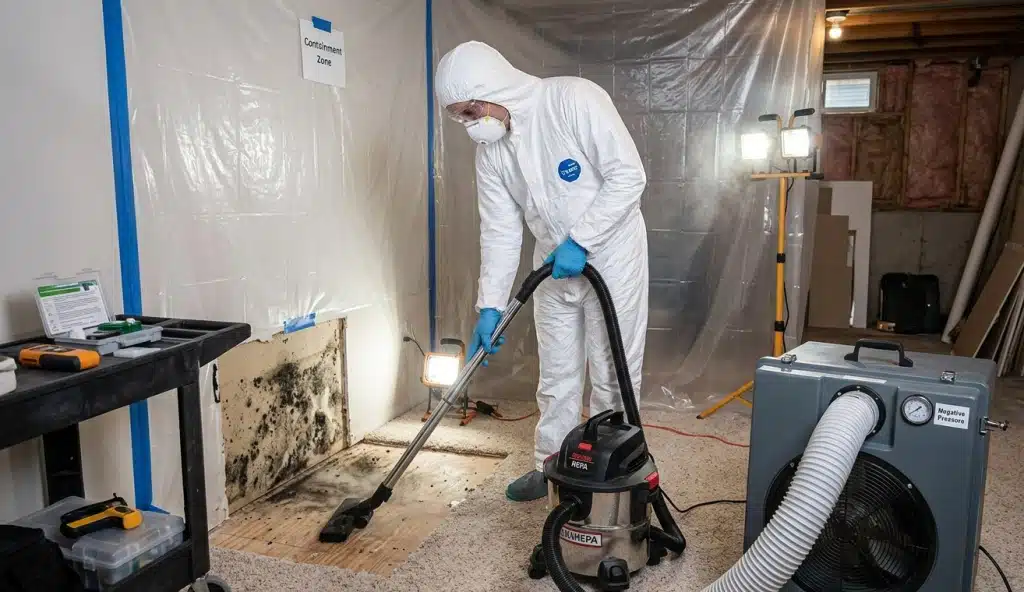
Professional mold remediation companies use containment procedures and specialized equipment to control the affected area while contaminated materials are being removed.
For larger or more complicated mold problems, that’s one of the biggest differences between professional mold remediation and DIY cleanup.
Mold Testing and Mold Remediation Are Not the Same Thing
This is an important distinction that many homeowners don’t realize.
Mold testing determines what is happening. Mold remediation addresses the contamination.
A-1 Certified Environmental Services specializes in independent mold inspection, testing, and post-remediation clearance testing. We do not perform the remediation work itself.
We believe that separation is important.
When the same company testing your home also makes money from the remediation project, there can be a potential conflict of interest.
An independent mold testing company doesn’t benefit financially from making the remediation project bigger than it needs to be.
Our job is to provide accurate information about the condition of your property so you can make an informed decision about what should happen next.
How Do You Know If Mold Is Hidden?
Sometimes you know something isn’t right even though you can’t see mold.
Maybe there’s a persistent musty smell.
Perhaps there was a water leak several months ago and the area never seemed to dry completely.
You might see staining on a ceiling or wall but aren’t sure what’s happening behind it.
These are situations where a professional mold inspection can help.
Mold testing may involve a visual inspection along with air or surface samples that are sent to a laboratory for analysis.
If you’re wondering what professional testing actually involves, our article about how to test for mold in your home explains what homeowners should know before trying to determine whether mold is present.
The goal isn’t to scare you into remediation.
It’s to determine whether there is actually a mold problem and, if there is, help establish how extensive it may be.
When Should You Call a Professional?
There isn’t one rule that applies to every property, but there are several warning signs that should make you think twice before tackling the problem yourself.
Consider professional inspection or testing when:
- Mold keeps returning after you clean it
- Multiple areas of the property are affected
- You smell mold but can’t find the source
- Mold appeared after flooding or significant water damage
- You suspect mold behind walls or underneath flooring
- There is evidence of an ongoing plumbing or roof leak
- Mold may have entered the HVAC system
- You are buying or selling a property with suspected mold
- You need documentation for an insurance, rental, or real estate matter
- You simply don’t know how extensive the problem is
The larger or more complicated the situation becomes, the less sense it makes to start tearing things apart without knowing what you’re dealing with.
What Happens If Professional Mold Remediation Is Needed?
If an inspection or testing identifies a significant mold problem, a qualified mold remediation company can develop a cleanup plan based on the affected materials and extent of contamination.
Depending on the situation, remediation may involve containment, air filtration, removal of damaged materials, detailed cleaning, drying, and correcting the underlying moisture problem.
But there is another important step homeowners sometimes overlook.
How do you know whether the remediation actually worked?
That’s where mold clearance testing comes in.
Don’t Skip Mold Clearance Testing
After spending money to have mold professionally removed, you shouldn’t have to simply take someone’s word that the job was successful.
Post-remediation mold clearance testing provides independent verification.
Ideally, clearance testing should be performed by a company that was not involved in the remediation work.
A-1 Certified Environmental Services provides independent mold clearance testing that can include visual inspection, air sampling, surface sampling when appropriate, and laboratory analysis.
Our article explaining the difference between mold testing and mold clearance testing provides more information about why this final step can be so important.
Think of it this way:
Testing before remediation helps identify the problem.
Remediation addresses the problem.
Clearance testing helps verify the results.
That gives you a much clearer picture from beginning to end.
Is Professional Mold Remediation More Expensive Than DIY?
Initially, yes.
A bottle of cleaner and a few hours of your time will obviously cost less than professional remediation.
But that’s only a fair comparison if the DIY cleanup actually solves the problem.
If mold continues returning because moisture or hidden contamination wasn’t addressed, you may spend more money repeatedly cleaning, replacing materials, repainting, or repairing damage.
The cost can increase substantially if mold and moisture continue damaging drywall, flooring, cabinetry, framing, or other building materials.
That’s why figuring out the extent of the problem first can potentially save money.
You don’t want to pay for remediation you don’t need.
But you also don’t want to treat a serious mold problem like a small cleaning project.
What About Using Bleach on Mold?
Bleach is probably one of the first things people think about when they discover mold.
But not every material can be treated the same way.
A hard, nonporous bathroom surface is very different from drywall, wood, carpeting, insulation, or other porous materials.
Simply making the visible discoloration disappear doesn’t necessarily mean the underlying moisture problem has been resolved.
Instead of immediately asking, “What can I spray on this?”, ask a more important question:
“Why is mold growing here?”
Find and correct the moisture source first. Otherwise, you may find yourself cleaning the same area again a few weeks or months later.
Mold and Indoor Air Quality
Visible mold isn’t the only concern.
Mold spores and other particles can become airborne, which is why mold investigations often overlap with indoor air quality concerns.
This can be particularly important in larger homes, offices, apartment buildings, schools, and commercial properties where HVAC systems move air throughout the building.
If you suspect mold but don’t see obvious growth, air sampling may provide additional information about what’s happening inside the property.
Our article about mold and indoor air quality explains more about the relationship between mold growth and the air inside your home or building.
Professional Mold Remediation vs. DIY: What’s the Right Choice?
There is nothing wrong with handling a truly small, straightforward maintenance issue yourself.
The problem is assuming every mold situation is small just because that’s all you can see.
If mold keeps coming back, follows significant water damage, appears in multiple areas, or may be hidden inside the structure, it’s time to get more information.
You don’t necessarily need to start with an expensive remediation project.
Start by finding out what you’re dealing with.
An independent mold inspection can help determine whether there is a significant mold problem, how extensive it may be, and whether professional remediation should be considered.
And if remediation is necessary, independent clearance testing can help determine whether the work was completed successfully.
Need Help Figuring Out What You’re Dealing With?
If you’ve discovered mold in your home or commercial property and aren’t sure whether it’s a simple cleanup or something more serious, A-1 Certified Environmental Services can help.
We provide independent mold inspections, mold testing, indoor air quality testing, and post-remediation clearance testing throughout California.
Call A-1 Certified Environmental Services at 888-217-2719 to schedule an inspection or discuss your situation.
Frequently Asked Questions
Is DIY mold removal effective?
DIY cleaning may be appropriate for a very small and straightforward surface issue when the moisture source is known and corrected. Larger, recurring, or hidden mold problems should be evaluated more carefully.
When should I call a mold professional?
Consider professional help when mold keeps returning, appears in multiple areas, follows significant water damage, or may be growing behind walls, underneath flooring, or in other hidden locations.
Should I test for mold before remediation?
Testing can be helpful when the extent or source of the problem isn’t clear. Independent testing can provide information that helps determine what type of remediation, if any, may be appropriate.
What’s the difference between mold testing and mold remediation?
Mold testing identifies and evaluates a potential mold problem. Mold remediation is the process of removing contaminated materials and addressing affected areas.
Does mold affect indoor air quality?
It can. Mold spores and other particles can become airborne and circulate through a home or building, particularly when mold growth is disturbed.
Should I test again after mold remediation?
Post-remediation clearance testing can provide independent information about the condition of the treated area after remediation has been completed.