
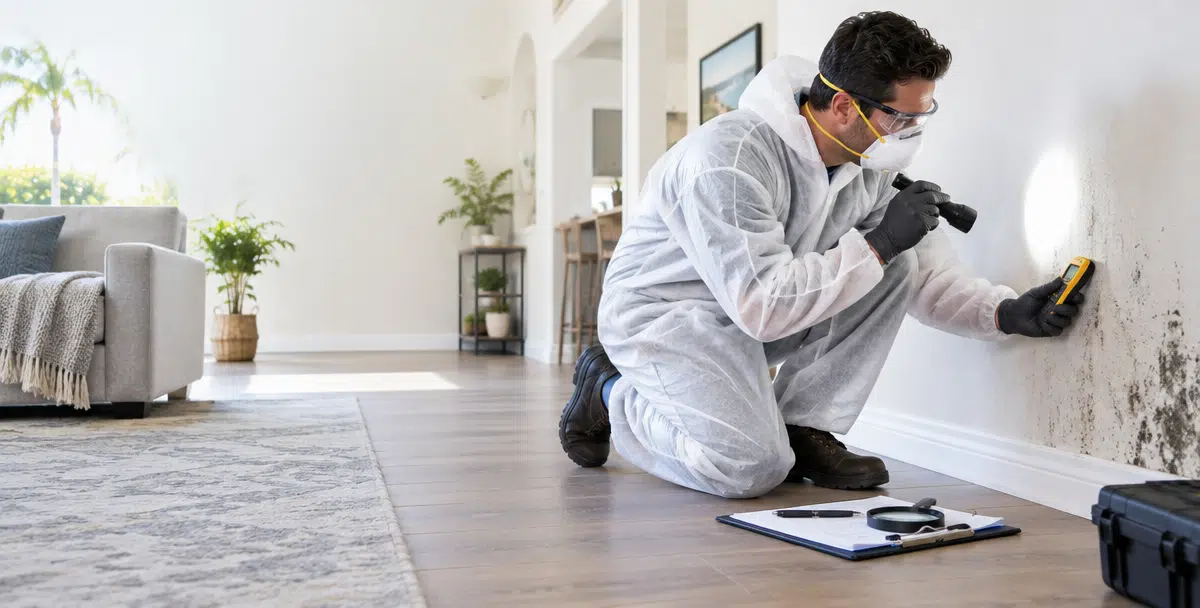
By Carl Gibbons, Lead Inspector, A-1 Certified Environmental Services
There is no California mold inspector license. The state requires no license, certification, or formal training to inspect a home for mold, and the same is true for the companies that remove it. The California Department of Public Health confirms there is no legal requirement in the state for training, licensing, or certification of mold assessors or remediators, while states such as Louisiana, Texas, and New York do require it.
That surprises most people. It means anyone can buy an air pump, print business cards, and start charging California homeowners to test their houses tomorrow. No exam, no state registry, no agency checking competence.
I’ve done this work for over twenty years. Here is what I think every homeowner should understand before hiring.
Does California require a mold inspector license?
No. And no certification or training requirement exists either. The state regulates the building, not the inspector.
A few related rules do apply:
Substandard housing. Senate Bill 655 added visible mold growth to California Health and Safety Code 17920.3 in 2015, the section defining substandard housing. A property owner must remediate if a code enforcer cites it. This is the legal hook behind most habitability complaints, and I’ve covered how it works in practice in mold in rental properties in California.
Workplaces. Cal/OSHA enforces moisture and mold rules in work environments.
Contractor licensing. Construction or improvement work valued at $500 or more requires a state contractor’s license. That covers demolition and rebuild during remediation — not inspection, and not lab analysis.
Does California have legal mold exposure limits?
No. CDPH states that science-based exposure limits for indoor molds cannot currently be established, and none exist in California.
The consequence matters: nobody can legally tell you your home passed or failed a mold test. There is no threshold to pass against. Anyone handing you a certificate declaring your home “mold-free” or “within legal limits” is describing something that doesn’t exist.
What a real report does instead is compare indoor samples against an outdoor control taken the same day, identify the species present, and explain what the gap between them suggests. That’s the process on every mold inspection and testing job we run.
What did the Toxic Mold Protection Act actually do?
California tried to regulate this. The Toxic Mold Protection Act of 2001, SB 732, directed health authorities to set permissible exposure limits and develop standards for identification and remediation.
The limits were never set. Mold sensitivity varies enormously between individuals, and there is no dose at which everyone reacts and below which nobody does. The framework exists; the substance was never filled in.
Can the same company test and remediate mold in California?
Yes. Some websites claim SB 732 prohibits a company from offering both assessment and remediation on the same California property. That is not accurate, and it’s worth correcting because people rely on it when choosing who to hire.
No such prohibition exists here. The confusion is likely with Florida, where the restriction is real — Florida Statute 468.8419 bars the same entity from performing both assessment and remediation on a property, with penalties escalating from misdemeanor to felony, and the state issues separate licenses for assessors and remediators.
Without a California mold inspector license system, one company here can inspect your home, diagnose the problem, quote the repair, perform the repair, and then test its own work to confirm it succeeded. All of it is legal.
What does the industry standard say about self-clearance?
Where state law is silent, the industry has its own guidance. ANSI/IICRC S520 is the recognized standard for professional mold remediation. Under it, a contractor clearing their own work is performing an internal quality check rather than independent post-remediation verification. Insurance carriers, attorneys, and property owners increasingly treat self-performed clearance as unverified.
This matters most when someone other than you will read the report: an insurance adjuster, a buyer’s agent, an attorney, a judge in a habitability dispute. A clearance test performed by the company that did the remediation carries considerably less weight in those settings than one from a third party with no stake in the outcome.
It also matters for scope. Not every mold problem needs a full remediation crew, and knowing where that line falls is something I’ve written about separately in professional mold remediation vs. DIY.
My position, stated plainly: A-1 performs testing and inspection only. We don’t remediate, so I have a commercial interest in the argument I’m making. I’d rather say that than pretend to a neutrality I don’t have. The underlying point isn’t mine — it comes from the industry standard and from how insurers and courts treat these documents. But you should weigh it knowing where I sit.
What should I ask a California mold inspector before hiring?
Since no California mold inspector license exists to screen anyone for you, the screening falls to you. Six questions worth asking:
Do you or any affiliated company perform mold remediation? The most important question. If yes, understand that the person diagnosing the problem also profits from the solution.
What certifications do you hold, and can I verify them? No state license exists, but national certifying bodies do. Ask for the certifying organization and the number. Then check it.
Which laboratory analyzes the samples, and is it accredited? The field work matters, but so does the lab. Ask for the name and its accreditation.
Will you take an outdoor control sample? Without one, indoor numbers mean very little. Mold spores exist everywhere; the comparison is what tells you whether something is growing inside.
Can I see a sample report before I book? A redacted past report tells you more about what you’re buying than any sales conversation.
What does this cost, and what’s included? In a market with no price regulation, quotes vary widely. Ours typically run between $190 and $1,000 depending on property size and how many samples are needed — I’ve broken down what drives that range in how much mold testing costs for a house. If someone offers a free inspection, ask who’s covering the lab fees and equipment. Usually it’s recovered in the remediation contract that follows.
The bottom line
The absence of a California mold inspector license isn’t necessarily a scandal. Plenty of excellent inspectors work here, and licensing in other states hasn’t eliminated bad actors. But it does shift the burden. In Florida, the state checks credentials for you. In California, you do.
Ask the questions. Verify the answers. And be particularly careful when the person telling you how bad the problem is happens to be the person who’d get paid to fix it.
This article describes California law as of 2026 and is general information, not legal advice. For a specific dispute — a habitability claim, an insurance denial, a real estate transaction — consult an attorney.
Carl Gibbons has over twenty years in construction and environmental science and holds certifications from Pro-Lab, ESA, and MASLabs. A-1 Certified Environmental Services provides independent mold and indoor air quality testing across California and performs no remediation work.
Resources:
https://california.public.law/codes/health_and_safety_code_section_17920.3